Summer Travel 2019 – Port Dickson (Days: June 20 – 29)

Port Dickson, Malaysia (PD as it is called) was where I completed my high school studies. It is a coastal town, south of Kuala Lumpur, that despite its coastline being now dotted with hotels and condominiums, is still able to exude its old small town charm. In 1963, my father was transferred by Shell Oil from Singapore to Port Dickson. We had a home there until he retired and I attended high school in PD from 1963 until I graduated in 1966.

After I left school and moved away, I still returned to PD on weekends. In recent years, each time we visit Malaysia, PD is always on the visit list. The old school is still there, still serving PD students. Many of my former school mates are still around and over the past three years I have been able to reconnect with many from more than fifty years ago.

I have been a member of the Port Dickson Yacht Club since 1970. When I left Malaysia in 1975, I maintained my membership, which I have to this day. This allows us to use the club facilities whenever we visit, including the rooms which we are able to stay at for only about US$20 a night.

Our visits to PD are always relaxing times by the pool and sea, with many meet ups with old classmates.  It is a blessing to be able to visit a place in the past that is still very much the same and with many friends still around. Most of my classmates are also in their seventies and have retired. This does not stop us from meeting and having a good time together.

Everyone has a special place they have fond memories of. PD is that special place for me. It was where I graduated from high school in 1966 and where Rhonda had her Peace Corps training in 1973. We met in PD and had our first date at the club. We enjoy returning to this special place and connecting with friends from many years ago.

Summer Travel 2019 – Malacca (Days: June 16 – 20)

From Singapore we took a bus across the causeway to the Malaysian state of Johore. We had to pass through Singapore and Malaysian immigration to do this. While in Johore we stayed for three days at the home of a friend who heads an International School in Johore Bahru. As Singapore International schools filled up, international schools opened across the border attracting foreign as well as many Singaporean children. While in Johore Bahru, we noticed the influx of Chinese investment in real estate, especially the very impressive Forest City.

From Johore Bahru we boarded a bus for the historic city of Malacca. Malacca was founded in 1403 by Parameswara, a prince from Indonesia who was displaced from his kingship in Singapore (then called Tumasek). Malacca was an important early trading port. Besides the early Chinese and Indian traders (many of whom settled there), Malacca was taken over by the Portuguese in the year 1511. This gave the area its initial Christian and European influence. The Dutch conquered Malacca in 1641 and exerted their influence in the area until they ceded Malacca to the British in exchange for Bencoolen in Sumatra under the Anglo-Dutch treaty of 1824.

The intermix of cultures in Malacca is evident in the racial mix found in Malaysia. Both the Dutch, Portuguese and English intermarried with the local Malay, Chinese and Indian women. The term Eurasian (or Serani) came to describe the people of such mixed origins – of which I am one. Besides, the European influence, the Chinese settlers who took on the Malay culture are known as the Nonyas and Babas (Peranakan). This mix of cultures has produced some of the best fusion foods that is only found in Malaysia and Singapore.

There is a lot of history to soak in during a visit to Malacca. The city is a living museum and very easy and interesting to walk around. We took advantage of the walk along Jonker road as well as the boat ride along the river. We stayed at the hotel Puri which is a converted Peranakan mansion with many artifacts of its own.

One of my most interesting visits was to the Cheng Ho museum. Cheng Ho was a Chinese admiral who sailed through the region. The Chinese were intrepid sailors well before the Portuguese and Spanish. This has prompted the book by Author Gavin Menzies, “1421 – the year China discovered the World.” Menzies a former British naval officer puts forward the theory that the Chinese discovered the Americas before Christopher Columbus.

We of course took the opportunity to sample the different foods in Malacca, especially the Peranakan flavors which originated from there. After a very busy three days exploring Malacca, we took a taxi up a coast to Port Dickson, the town where I completed my high school studies.

Summer Travel 2019 – Singapore (Days: June 10 – 15)

Singapore is an easy city to live and get around in. The first impression you get when you land is the beautiful and efficient international airport. From the airport you have the option of taking a taxi or the MRT (Mass Rapid Transit) system to almost anywhere on the island. It is interesting to note that just less than a century ago, Singapore was mainly a fishing center with only a deep water trading port as its main asset. Today, the people of Singapore are definitely its main asset. Under the guidance of a graft free, progressive and enlightened government, the island has been transformed into a social, cultural, technological and economic hub that begs emulation.

Most Singaporeans own their own homes, thanks to the Central Provident Fund, a system of compulsory work savings (with a shared employer contribution) that allows every working individual to amass a sizable retirement savings that they can draw upon before retirement to finance a home purchase. The facilities around the island, from the cheap and efficient transport systems to the cultural parks, educational centers, gardens, and well designed and marked walking hiking trails are all designed for a people that has learned to value and maintain a healthy and satisfying standard of personal and community well being.

Singapore is a cosmopolitan city with an ethnic mix of Chinese, Indians, Malays and peoples of mixed ethnicity, the product of many interracial marriages. In planning housing for the city, the government was careful to ensure racial integration that has allowed younger generations to grow up in a truly multi-racial environment. It is very common to witness racially mixed groups enjoying a meal together at the many restaurants we visited. There is also an expatriate community of foreigners, some who have permanent residence and call Singapore home. There are other expatriates who work for the many multi-national organizations that choose to base their Asian operations in Singapore.

From our homestay base in Holland Village, we had ready MRT access to the city. We purchased MRT passes with a USD 10 credit and after four days of daily use still had a few dollars credit left over. There is really no need to rent a car in Singapore.

There are many well planned and safe walking trails across the island. The impression one gets is that everything planned and built in Singapore is done with the needs of the populace in mind.

The following photographs are just a personal sampling and do not do justice to the full appeal of the city.

Summer Travel 2019 (Days: June 9 and 10)

This summer our travel took us back to Singapore and Malaysia. Our journey began on the early morning of June 9, when we boarded China Eastern Airlines from Vancouver, Canada to Singapore. The flight departed Vancouver at 2:30 am and we spent 12 hours in the air before landing in Shanghai, China. Other than the rather cramped seating (typical of most airlines nowadays) the flight and service was good. We chose China Eastern because we wanted to visit my brother on the way back to Vancouver. We booked our flight about four months in advance and the round trip fare was US$600 per person.

On landing in Shanghai, we has a four hour layover before our connecting flight to Singapore. We took advantage of the long concourse to do some walking and having some dim-sum at one of the airport’s food outlets.

Our flight to Singapore was uneventful and we took in a movie starring Anthony Hopkins – The Human Stain – based on the novel by Philip Roth. After a total journey time of 22 hours, we landed in Singapore at 4 pm on Sunday, June 10. Singapore is approximately twelve hours ahead of US Eastern time. Disembarkation was very smooth and efficient and within forty minutes we were in a taxi on the way to our homestay.

Our homestay in Singapore was a studio apartment about a ten minute walk from Holland Village. The location offered us privacy, convenience, and comfort. It cost us about US$45 a night, a bargain for what we got in facilities and location.

We unpacked for our five day stay and walked to the Holland Village market for our evening meal of a pint of Guiness and Singapore Char Kway Teow  (a delicious concoction of stir fried flat noodles and various condiments). The drinks and meal for the two of us cost US$12.

After our meal and a walk around the area we headed back to our homestay for the night. We were tired and in bed by 9 pm. We knew however that it would take a couple of days to adjust to the time change.

In the upcoming posts of our trip, there will be quite a few pictures of food. Singapore and Malaysia has some of the best foods in the world and there were times in the past when we actually planned our trips around the food we would eat.

The Sacredness of Now

How much time do we spend daydreaming or reflecting on the past and contemplating the future? The time we spend on the past and the future takes away from the very thing that effects them – the Now. The past was once the Now and the future is shaped by the Now. Sure, we do have to spend time planning for the future, and constructively reflecting on the past, but we also need to try our best to make the Now matter.

The following words from Mark’s gospel show us plainly how we are to live in the Now. The Now should be infused with the love of God and neighbor and in so far as we do this well, we redeem the past and build a future without fear.

“Which commandment is the most important of all?” Jesus answered, “The most important is, ‘Hear, O Israel: The Lord our God, the Lord is one. And you shall love the Lord your God with all your heart and with all your soul and with all your mind and with all your strength.’ The second is this: ‘You shall love your neighbor as yourself.’ There is no other commandment greater than these.”

To bring this into more practical terms, I offer the following simple scenarios as little illustrations.

The morning alarm rings. Do you procrastinate in bed, not wanting to get up and wishing it were the weekend; or, do you offer thanks for the new day, rise and follow a routine that will help you fully meet the new day and all it has to offer.

You are seated comfortably with your own thoughts, when your wife, child or colleague invites you to help them with something. Do you wave them away with a dismissive “not now” or, give them your full attention, time and consideration.

You hear news of a disaster. Do you say, “poor things” and move on with the day; or, do you at least offer a prayer for the victims or try to help out in some small way.

You are on a hike. Do you walk mindlessly or do you walk with your senses fully awake, taking in the wonder of the sights, sounds and smells around you.

You are traveling on a train or plane seated next to a fellow traveller. Do you bury yourself in a book or sleep; or, do you make an attempt to communicate and at least acknowledge his or her presence.

I have, at one time or another, been personally guilty of each one of the self-indulgent sides of these scenarios. When I consider that we are are all children  of God, and created in His image, I shudder at my ability to neglect and waste the God given opportunities of the Now. I know that changing my attitude and habits towards the Now opens the flow of Blessings that God wills for all of us. Treating the Now as sacred, as God intends it, is all there really is. Our knowledge of God and his Will for us increases. Our family and personal relationships become more genuine, meaningful and fulfilling. Our work, seen as Now opportunities and free from deadly procrastination, increases our learning, contributions, satisfaction and well being. Our appreciation and acknowledgment of God’s many gifts of creation unveil to us the fullness of their splendor and glory;

We are all self-indulgent, self-caring individuals and it is certainly not wrong to take time for ourselves. What we should consider is whether our self-indulgence takes up most of our Now, thus crowding out the opportunity for God and neighbor. May we, with God’s help, slowly but surely, change the quality of our Now, and enrich ourselves with fuller relationships of God and neighbor through the daily opportunities He sends us.

On Turning 70

Today I turned 70. Wow! How did that happen? As I reflect on this milestone, I have to look back and thank God for my many blessings. I am particularly thankful for,

  • the gift of my Catholic Faith and Jesus my Lord and Savior who has been my rock in good as well as challenging times.
  • my parents Rachel and Felix, who through their love and example largely formed who I am.
  • my beloved family: my wife Rhonda; children Ryan and Camille; daughter-in-law Amber; and grandchildren Annabelle, Asher and Rowan, all of whom make my life so much richer.
  • my siblings Miles, Charles, Anne, Bernadette (who is with God) and their families, who though physically far away, always remain close in thought and prayer.
  • relatives and friends from around the world who have touched and continue to touch my life.
  • the gift and opportunities for service and work that offered so many experiences, learning, and the necessary remuneration for sustenance over the past fifty years.
  • my places of work and service and work colleagues at the following places: The Government English Primary School, Port Dickson, Malaysia; James Warren & Company (later Scott & English), Malaysia; Perma Inc. in both the Philippines and Indonesia; PT Sande Jaya, Indonesia; The American College, Singapore; North Country School, Lake Placid, NY; The American Community School, Amman, Jordan; Canadian Academy, Kobe, Japan; Christ the King Catholic School, Tampa, Florida; and, Tampa Catholic High School, Tampa, Florida.
  • my education that enables me to think for myself and test ideas and philosophies for truth and meaning.
  • the schools that I have been privileged to attend and the teachers and fellow students who contributed to my education: St. Anthony’s, Teluk Anson, Malaysia; La Salle, Klang, Malaysia; De La Salle, Singapore; St. Joseph’s Institution, Singapore; Government English Secondary School, Port Dickson, Malaysia; Technical College, Malaysia; Durham University, England; and the many conferences and workshops that I have been privileged to attend throughout the years.
  • students, teachers and administrators who have shared my journey as an educator over the past thirty years.
  • the opportunities to travel extensively and experience other cultures and learn from them. I visited cities in Malaysia, Singapore, Thailand, the Philippines, Indonesia, Vietnam, China, Hong Kong, Cambodia, India, Nepal, Sri Lanka, Japan, Australia, Austria, Belgium, Holland, England, Italy, Ireland, France, Switzerland, Germany, Greece, Slovakia, Russia, Hungary, Ukraine, Israel, Jordan, Syria, Lebanon, Bahrain, United Arab Emirates, Turkey, Egypt, Mexico, Honduras, the Bahamas, Belize, and almost all of the states in the US.
  • my health. I am particularly thankful for my wake-up triple by-pass in January 2008 which led me to adopt better health habits of mind, body and spirit. I realize that while I rest my life in the will of God, it remains my responsibility to do my part to keep healthy. I pray that God will grant me continued good health in my coming years.
  • my now retirement, with time for family, leisure, continued learning, and,  whatever else the future may hold.

I give thanks.

A Backyard Project

What do you do with a backyard that is somewhat rooted and shaded and does not support grass growth? Mulch is low maintenance, but gets washed away in the rains. We toyed with building a deck or even a stone patio area. After a lot of thought and some research, I decided that an area of artificial turf would best suit our needs. It would be a great sit-down area and a nice romping space for the grandkids.

Most of my projects are learned on the job. I cannot always afford the cost of someone else’s labor. So I try to do the learnable and doable myself and leave the more critical and complex projects to the experts.

The first step was to measure out the area to avoid as many tree roots as possible. We love our oak tree and its shade! The ideal area worked out to be a 14 by 13 foot rectangular space. While we could have just put the artificial turf down on the ground, we decided to do the extra work to get it right.

(1) The area was measured and marked out and the odd clumps of grass sod removed. After raking, leveling and compacting the ground, paver borders were fixed to mark and contain the project.

The picture below shows the area marked out, leveled and compacted.

IMG_0520

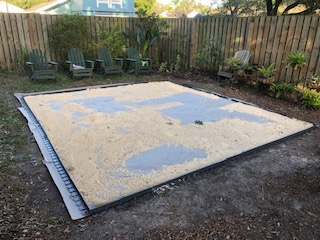
(2) Next the area was covered with weed mat and sand for further leveling.

IMG_0521

(3) An underlayment was then placed over the leveled sand to prepare the surface for the artificial grass.

IMG_0524

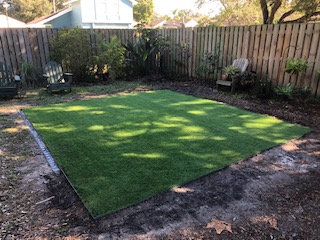
(4) The artificial grass was then rolled onto the area and secured.

IMG_0528

(5) Finally a decorative perimeter of bricks was secured in place with paver borders.

IMG_0630

The project area is slightly raised and gently sloped away from the house to allow for drainage and to keep it useable even on wet days.  We had a few really wet days and have noticed that the area drains well and dries fast. The backyard is now much more enjoyable and grandkid friendly!

For Lent – A Simple Examen

Lent is always a time for personal reflection and improvement. The Jesuits have a reflective exercise known as the Examen. I use a simplified form of the Examen and offer it as something to try during this Lenten season. I make a habit of doing this reflective exercise in the quiet of each night before I go to sleep.

Step 1: Acknowledge and be thankful for the many good things in your life. After you do this for a while, you will have a key list list of important people and situations that you give thanks for each night. Next, be thankful for the particular day that you just lived. Try and specifically recall at least one thing from the day that you are thankful for.

Step 2: Deliberately go over the events, situations and interactions of the day from the time you woke up in the morning. Pay attention to any of your thoughts, words and deeds that may not have been as loving as they could have been. Reflect upon how these can be reframed differently in the future. Identify, if it presents itself, a particular behavior that you know you should cease or improve upon.

Step 3: Ask God to forgive your shortcomings of the day and pray for the grace to do better tomorrow. Offer the one behavior you identified in (2) above to God, commit to cease or improve the behavior, and pray for the grace to keep your commitment.

Step 4: If there is something heavy on your heart, offer it to him and leave it in His hands. Take some time to silently remain in His presence and just listen as you drift off to sleep.

Sometimes, the next morning you may awake with a helpful thought or a meaningful dream. At very least, I find that I often awake restful and at Peace.


Keeping Healthy

In 2007 I received 4 coronary stents. This was followed by a triple coronary bypass in January 2008. This was a big wakeup call to examine a number of things in my life. Except for a stint in hospital when I was twelve, I had not experienced any illness other than the occasional flu and cold. I had never seriously considered the importance of diet choice and lifestyle habits before, but these cardiac incidents definitely pushed me in that direction. The habits I list below are ways I try to keep healthy and they are personally what works for me. I still very much value the recommendations of my primary doctor and my cardiologist, both of whom I visit at least once a year.

Water: Water is now my primary choice of drink. I do not drink any sodas. I do drink alcohol but confine my alcoholic intake to no more than two drinks at a sitting. On average this works out to about five drinks a week. My only other liquid intake is a cup of coffee or tea a day. I drink at least 3 glasses of water each morning as soon as I wake up, which is about 45 minutes before I consume my breakfast shake. I also make sure I drink a glass of water before a meal, after I exercise, and before I go to bed at night. The water should preferably be at room temperature and not ice cold. I have been doing this water regimen regularly for the last five years, and, except for getting used to the initial morning glasses of water, have experienced no ill effects from it. I believe that the proper consumption of water plays a major role in keeping us healthy.

Diet: Rhonda and I have tried many different diets since my health episode, including ones that are low fat and vegan inspired. Although I strongly believe in a plant based diet, for more practical purposes, we’ve now comfortably settled on a retirement diet that leans towards being plant based but still includes some portions of meat or fish. I’m personally not too concerned about fats consumed in small amounts, but I do keep away from deep fried and junk foods. Breakfast consists of a vegetable/fruit shake fortified with a protein powder. Lunch is the main meal and is usually vegetables, rice and some meat or shrimp. We vary flavors and sometimes include spicy curries. On other days I go down to the local Cuban Home Food Restaurant for a takeaway of black beans, yellow rice, plantains and fish. Dinner is a salad or sometimes, just a beer. I occasionally have a juicy steak but limit that to special occasions. My diet does not preclude me from dining out, having the occasional pizza or pasta, but this then becomes the main meal of the day. We’ve discovered that our system of one main meal a day with the vegetable/fruit shake in the morning provides the necessary sustenance and prevents over eating. We have also cut added sugars from our diet. We do not add sugar to coffee or any food. Our daily dessert is a couple of pieces of dark chocolate mainly in the evening. This does not stop us from occasionally having a sweet dessert when we dine out. We however tend to be vigilant about the amount of sugar we include in our diet on a regular basis.

Exercise: One of my investments after my triple by-pass was a Concept 2 Rowing machine. This is probably one of my better health investments as I have used it regularly and have logged close to 8,000,000 rowing meters on it. Rhonda and I motivate each other to exercise at least five times a week. Besides the Concept 2, we also have a NordicTrack Elliptical, which is Rhonda’s main machine. On weekdays I spend about 25 continuous minutes a day on the machines. I also do some simple body-weight squats and pushups on alternate days for strength training. Whenever I feel my back beginning to act up, I include some lower back exercises as well. Weekends are rest days, but that does not mean we cannot throw in a long hike or walk.

Supplements: At one time I took too many supplements. I now take daily, a multivitamin, a magnesium capsule, a fish oil capsule, and a COQ10 capsule (recommended for users of statins). My only regular daily prescribed medications are a statin (10 mg), Lisinopril (5 mg), and a low dose aspirin (85 mg). I also add some turmeric and a teaspoon of coconut oil to my morning coffee.

Numbers: My current numbers are: Age: 70 yrs (in Aril); weight: 190 lbs. (my ideal is 185); height: 73 ins; Cholesterol: 122; HDL: 58; LDL: 52; Triglycerides: 58; PSA: 2.8; Glucose: 101. The only number that is currently slightly high is my glucose level. I have been able to keep that just on the high side of the normal range or slightly over. BP range is (110 -130)/(60 – 80) with the 5 mg of lisinopril.

Lifestyle: Retirement does help lower the stress level which is an important but often overlooked health factor. My Faith life helps keep me grounded. I am also very fortunate to have a wonderful and supportive wife, and children and grandchildren close at hand. Family, good friends, relationships and connections are great for our health.

I certainly believe these habits have kept me healthy and feeling good. I am thankful for my good health over the past years and intend to continue doing my part.

I shall add a new post and link to this post whenever my own action research on healthy habits confirms something else. I’ll also, mainly for my benefit, include annual updates with any changes to the habits and numbers above.

Universal Basic Income

I am very glad I found Andrew Yang’s book, The War on Normal People. It affirmed my own ideas and clarified a number of issues for me. Andrew is a bright non-politician who has declared his candidacy for the 2020 presidential elections. He may be a long-shot for the presidency, but he would make a major contribution if his ideas are able to influence the political agenda. He is a proponent of  Universal Basic Income (UBI), which is one of the solutions put forward to deal with disruptive technological shifts. Since many of you may not have the time to read his book (although I strongly recommend it), I will freely quote below from one of his chapters. UBI is not a new concept. Some form of UBI has been seen as an imperative by many voices.

Quote: Today, people tend to associate universal basic income with technology utopians. But a form of UBI almost became law in the United States in 1970 and 1971, passing the House of Representatives twice before stalling in the Senate. Versions of the idea have been championed by robust thinkers of every political persuasion for decades, including some of the most admired figures in American life. Here’s a sampling: Thomas Paine, 1796: Out of a collected fund from landowners, “there shall be paid to every person, when arrived at the age of twenty-one years, the sum of fifteen pounds sterling, as a compensation in part, for the loss of his or her natural inheritance,… to every person, rich or poor.” Martin Luther King Jr., 1967: “I am now convinced that the simplest approach will prove to be the most effective—the solution to poverty is to abolish it directly by a now widely discussed measure: the guaranteed income.” Richard Nixon, August 1969: “What I am proposing is that the Federal Government build a foundation under the income of every American family… that cannot care for itself—and wherever in America that family may live.” Milton Friedman, 1980: “We should replace the ragbag of specific welfare programs with a single comprehensive program of income supplements in cash—a negative income tax… which would do more efficiently and humanely what our present welfare system does so inefficiently and inhumanely.” Bernie Sanders, May 2014: “In my view, every American is entitled to at least a minimum standard of living… There are different ways to get to that goal, but that’s the goal that we should strive to reach.” Stephen Hawking, July 2015: “Everyone can enjoy a life of luxurious leisure if the machine-produced wealth is shared, or most people can end up miserably poor if the machine-owners successfully lobby against wealth redistribution. So far, the trend seems to be toward the second option, with technology driving ever-increasing inequality.” Barack Obama, October 2016: “What is indisputable… is that as AI gets further incorporated, and the society potentially gets wealthier, the link between production and distribution, how much you work and how much you make, gets further and further attenuated… we’ll be debating unconditional free money over the next 10 or 20 years.” Warren Buffett, January 2017: “[Y]ou have to figure out how to distribute it… people who fall by the wayside through no fault of their own as the goose lays more golden eggs should still get a chance to participate in that prosperity, and that’s where government comes in.” Bill Gates, January 2017: “A problem of excess [automation] forces us to look at the individuals affected and take those extra resources and make sure they’re directed to them in terms of re-education and income policies…” (Gates later suggested taxing robots.) Elon Musk, February, 2017: “I think we’ll end up doing universal basic income… It’s going to be necessary… There will be fewer and fewer jobs that a robot cannot do better. I want to be clear. These are not things I wish will happen; these are things I think probably will happen.” Mark Zuckerberg, May 2017: “We should explore… universal basic income so that everyone has a cushion to try new ideas.” Unquote. (Yang, Andrew. The War on Normal People (pp. 166-168). Hachette Books. Kindle Edition)

Yang calls his version of UBI the Freedom Dividend. He is proposing $12,000 (indexed to inflation) per person per year between the ages of 18 and 64 independent of their wealth status or income. The Freedom Dividend would replace a majority of the existing welfare programs. Yang contends that UBI will eliminate the disincentive to work that may be inherent in existing welfare programs. With UBI, if you work you can actually start saving and getting ahead.

Some other incentives of UBI that Yang argues for:

  • It would be a massive stimulus to lower-cost areas.
  • It would empower people to avoid making terrible decisions based on financial scarcity and month-to-month needs.
  • It would be a phenomenal boon to creativity and entrepreneurship.
  • It would enable people to more effectively transition from shrinking industries and environments to new ones.
  • It would reduce stress, improve health, decrease crime, and strengthen relationships.
  • It would support parents and caretakers for the work that they do, particularly mothers.
  • It would give all citizens an honest stake in society and a sense of the future.
  • It would restore a sense of optimism and faith in communities around the country.
  •  It would stimulate and maintain the consumer economy through the automation wave.
  • It would maintain order and preserve our way of life through the greatest economic and social transition in history.
  • It would make our society more equitable, fair, and just.

Yang calls his version of UBI the Freedom Dividend as he uses the analogy of a company distributing profits to its shareholders. Are citizens not similarly owners of the country entitled to a return on GDP – especially since GDP, with the help of robots can increase at human expense? In his book Yang offers practical ideas and ways to finance UBI.  If we can spend billions of dollars bailing out banks without any return, we can surely restructure our economy to support UBI and improve the quality of life for our citizens.